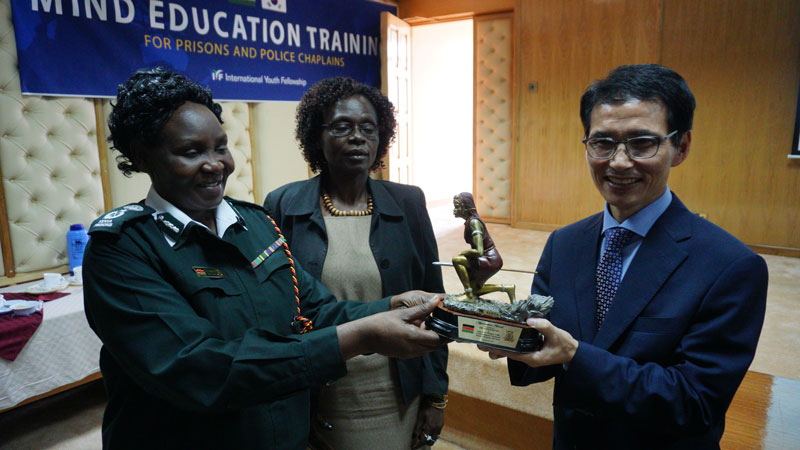
Wardens and Inmates Smile as mindset Education Boosts Prison Reforms
The Kenya Prison Service that signed an MoU with International Youth Fellowship to give Mind Education to wardens and inmates is now bearing fruits.In one week IYF trained 2,400 prison service cadets from the Ruiru prison college , 30 senior officers at the National headquarters and 400 inmates at the at Ruiru prison. On the 4th and 5th September 2017 120 prison chaplains and senior officers at the IYF headquarters in Nairob also underwent a training.

The rate of recidivism in Kenya is estimated to be about two thirds, which means that two thirds of inmates will go back to prison after their release from prisons. However there is new hope for change in the country after the Kenya prison service adopted mind education as a behavior and character training for its officers and inmates.

The 120 Kenya Prisons Service officers are among the first batch of beneficiary with a two day mind education training at the international youth fellowship headquarters in Nairobi, Kenya. The program targeted chaplains from the correctional facilities to foster mind change among the wardens and inmates. The training was conducted by a reformed convict turned mind lecturer, Dr. Kim Ki-Sung from South Korea.
I entered prison because of murder and theft. On the first judgment I received a death sentence, on the second judgment I received 15 years imprisonment. As I stayed in prison I received an additional 1 year prison sentence.” Said Dr. Ki-Sung.
Dr. Ki-sung who was in jail for 16 years explained why the rate of recidivism is still high despite numerous inputs towards reforming the inmates.

Dr. Ki-sung argued how many inmates hold on to their thoughts that the stereotypes in society would not welcome them once they leave prison. “The problem is that people have a problem holding it back, and so people hold it and hold it, and hold it. And when they come to certain limitations, people explode.” He added.
Due to the growing number of criminal cases there has been a dire need to decongest prison facilities in Kenya. But the greatest challenge facing correctional facilities is the high rate of convicts finding their way back to prison raising the question; what needs be done to mitigate this growing societal threat? According to one of the chaplains who attended the two day mind education training conference the big problem is not just with the inmates attitude but the wardens also need to come on board if the problem it to be curbed.
Most of us (Prison wardens), and I do say this. And I will not feel sorry to say this. We are in prison we, more than the prisoners who we are rehabilitating,” said Francis, a prison chaplain reacting to a session by Dr. Ki-Sung. Change in life begins with the change of mind.

According to the lectures that ranged from why people end up in prison, why inmates live a revengeful life and why the rate of going back to prison remains high provides answers to all this questions. Dr. Kim Ki-Sung says it all begins from the aspect of avoiding challenges and desiring a comfortable life. Furthermore, Dr. Ki-Sung revealed how people have no option but to commit offences when they think that they are able to control themselves and overcome by applying effort and determination.
Most offenders think of easy ways of doing things while others are working hard. Most offenders have that formation of the heart.” he said. “It is very important people to learn when they are very young, those who did not learn self control from childhood and those who did; there is a very big difference. When they work in a company, when they meet marital problems or are in business, this determines failure or success.” added Dr. Ki-Sung. Change in life begins with the change of mind.
Mind education is from this school of thought and it gives a bigger and positive impact to the inmates once they serve their time. Wardens attending the two day seminar embraced the thought that the worst problem is not the societal ills but a society that possesses a weak heart.
“A weak heart does not just come” Explains Dr. Ki-Sung, “you develop a weak heart when you have the mind of avoiding.” He says. “When you try to avoid difficulties and challenges from a young age, you grow weaker and weaker in the heart as you age.” He continued to explain that “If you live with such a heart, you eventually develop the mind to trust in yourself and that is where all people begin to fail and end up committing offences without regard to what other say”.

Listening to the life story of Dr. Kim Ki-Sung not only rejuvenated the spirit of the wardens, but enlightened their thinking and observation of life in general and most importantly the approach to communication and human relationship. By the time the workshop was ending the attendants were so happy and they all had one observation, “should this meeting be organized again, they would definitely attend without failure, further still 90 percent of them recommended that this education be brought to their work stations.
Dr. Kim Ki-Sung during a training for 30 senior prison officers at the prison headquarters in Nairobi, Kenya.


The workshop was so vibrant and uplifting to the spirits of the wardens who went away with a jovial heart. Imagine a system where they can daily learn and apply what they are taught about the world of the heart. That is an environment where most people can only imagine in their wildest dreams. But in reality, those who come to learn the world of the heart through mind education can experience such joy and erase all complain and blame in their heart.
The MoU between IYF and the Kenya Prison Service and National Police Service is the beginning of a change that will sweep across Kenya’s correctional facility and law enforcement sector that will instill sobriety and open mindedness in the way law enforcement view their client hence promoting regard for human rights and adherence to human dignity which is a fundamental constitutional requirement.
Finally, offenders can also learn about what causes them to offend and turn from the self trusting heart that leads them to go astray and this will play a key role in mitigating rate of recidivism in Kenya.